HAIQ & DDFA Product Architecture
HAIQ is our governance platform for clinical AI. Today, DDFA audits models retrospectively on de-identified historical data, team-operated, with no EHR integration. Continuous monitoring via HL7 FHIR R4 is on our 2027 roadmap.
The Complete HAIQ Governance Engine
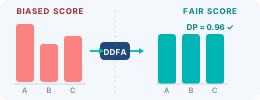
DDFA (Data Diversity & Fairness Auditor)
The core auditing engine. Evaluates clinical AI models on de-identified historical data, calculating the Composite Fairness Index (CFI) across demographic matrices.
Explore DDFA Specs →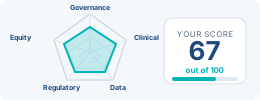
EAMA (Ethical AI Maturity Assessment)
A free, 15-minute self-serve diagnostic that benchmarks institutional AI governance readiness and maps regulatory exposure for executive leadership.
Take EAMA Assessment →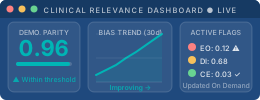
CRD (Clinical Relevance Dashboard, in development)
Translates DDFA signals into administrator-ready equity metrics, disparity trend reporting, and executive committee reporting.
View CRD Dashboard →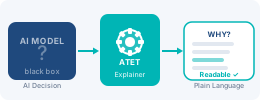
ATET (Algorithmic Transparency & Explainer Tool, in development)
Being developed to explain audit findings to clinicians in plain language, including where model recommendations diverge for specific patient demographic groups.
SCF (Synod Certified Fairness, in development)
An assurance designation we are developing for release in 2027, for hospital networks and commercial AI vendors. SCF is not yet operational and is not accredited by any third party.
Fairness Foundations (FF)
A structured 12-week capacity-building curriculum for healthcare organizations establishing AI governance, including train-the-trainer modules for Equity Champions.
DDFA Architecture & Data Pipeline
How the Data Diversity & Fairness Auditor evaluates de-identified model outputs retrospectively to compute Composite Fairness Index scores, with point-of-care EHR workflows on the 2027 roadmap.
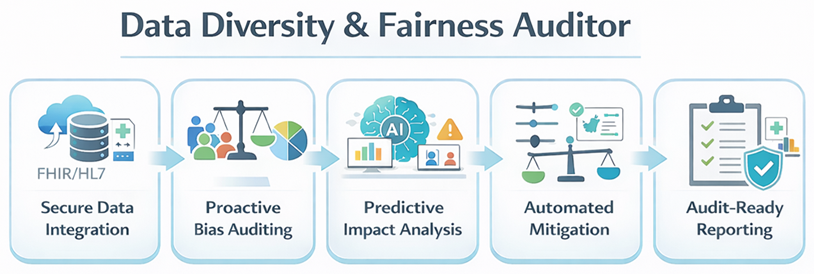
Figure 1: DDFA pipeline. Sidecar historical audits are available today; HL7 FHIR R4 point-of-care verification is on the 2027 roadmap.
The Fast Path Capacity Building Engine
Phase 0: Benchmark Readiness
Execute the free EAMA online assessment in Week 1 to identify institutional policy and governance gaps.
Phase 1: The Fast Path Capacity Building Engine
Scope a Preliminary Disparity Report on de-identified historical model outputs. Timing and deliverables depend on data suitability, approvals and a signed scope. No live EHR integration is required; engagements proceed under standard institutional data governance and privacy agreements.
Phase 2: Expanded Retrospective Cohort Analysis (Roadmap)
Multi-site analysis on historical care pathway cohorts. A roadmap item that is not currently offered.
Phase 3: Enterprise Foundation
Convert to multi-department enterprise licensing with CRD reporting and Synod Certified Fairness (SCF) designation once both launch.